
The importance of fashion sketching lies in making an idea visible enough to question. A hand-drawn fashion sketch lets a designer compare a neckline, move a waist seam or reconsider sleeve volume before those decisions become a pattern and a sewn garment. Its value comes from the decisions it supports, rather than how polished the page looks.
A drawing is also selective. It may explain a mood beautifully while leaving the back, fastening and fabric behaviour unresolved. Treating that selectivity deliberately is the first step towards using sketches well in garment development.
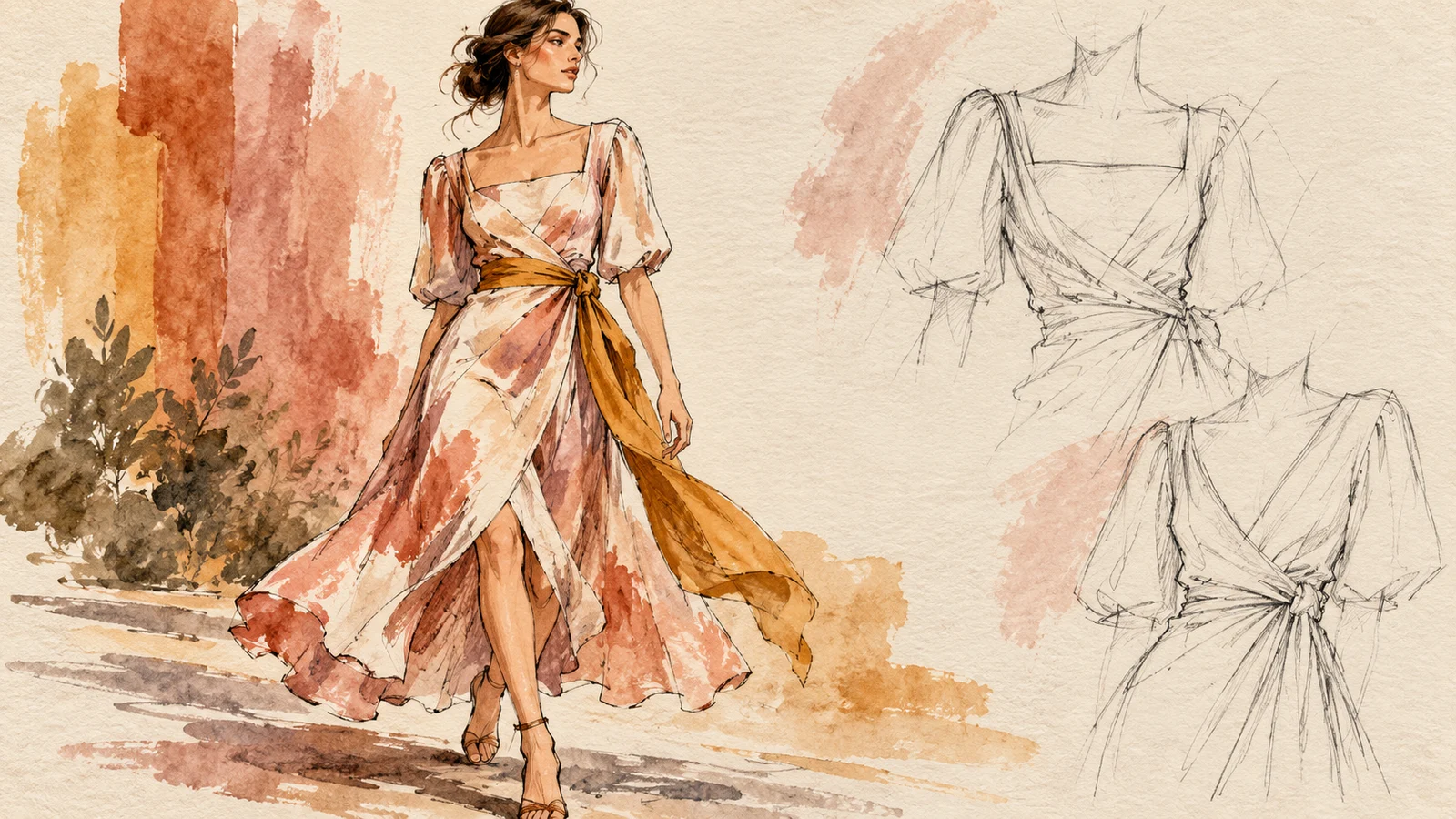
Start with the decision the drawing must help you make
Consider an illustrative brief for a woven day dress: the designer wants a defined waist and a skirt that moves when walking. Three quick drawings could compare a waist seam with gathers, a panelled skirt and a wrap treatment. Each option raises a different construction question. The sketch makes those alternatives discussable; it does not establish which will work in the chosen fabric.
Write one sentence beside each version explaining what changed and why. If every detail changes at once, it becomes difficult to identify what made one option stronger. A useful sketch page preserves that reasoning, including rejected options.
Separate the silhouette from the styling
A long-legged figure, tilted shoulder or sweeping pose can make clothing appear narrower, longer or more fluid. These are legitimate expressive choices. They become a problem only when the team reads the image as a measurement instruction.
Review the garment outline without accessories or dramatic shading. Ask whether the design still has the intended balance when shown on a neutral figure and from the back. Keep the expressive illustration, then add a simpler view to answer the structural questions it cannot show.
Use annotation to preserve design intent
A short note can prevent a line from carrying several meanings. State whether the waist is shaped by darts, an elastic channel, a seam or a separate belt. Identify which folds are intended fullness and which are simply an indication of movement. Mark an uncertain detail as open instead of presenting it as an approved instruction.
- Design anchor: the feature that makes the style recognisable.
- Variable: a feature that may change after material or fit review.
- Open question: a decision that needs a swatch, pattern trial or sample.
This three-part note is an editorial working method, not an industry certification or required document format. Its purpose is to help the next person understand your priorities.
Know when the sketch has done its job
A sketch can express the intended relationship between body, cloth and volume. It cannot confirm wearing comfort, seam appearance, opacity or dimensional stability. These questions require specifications and appropriate physical review. Hand drawing is useful alongside digital drawing, patternmaking and draping; it is not a mandatory starting point for every designer.
As an educational reference, FIT’s Fashion Design–Art course descriptions connect sketch communication with garment details, silhouette and colour. The practical framework in this article is an original explanation of how to organise those design decisions.
Carry the idea into a usable manufacturing brief
Once the direction is selected, develop front and back technical views, identify materials and define measurements and construction. Link the chosen sketch to a style code and revision so the original intention can be compared with the sample later.
KEYIDI TEXTILE reviews women’s woven-apparel projects from a complete tech pack with production-ready drawings and specifications, or a physical sample garment. A concept sketch alone is insufficient to start development. Our garment sampling requirements explain the starting materials; the woven-apparel tech pack checklist covers the supporting documentation.
When those materials are ready, send your woven-apparel project for review with quantities, material status and your intended delivery window. Review of the brief does not itself confirm production acceptance, price or timing.
Ready to Discuss Your Next Collection?
Send your garment brief, tech pack or physical sample details, fabric requirements, and target quantities for review.
Formal development requires a complete production-ready tech pack with specifications, or a physical sample garment. Concept sketches alone are not sufficient to start development.
Send Production Enquiry ↗Or email us directly at info@keyiditextile.com