
Fashion illustration and technical drawing answer different questions. An illustration helps people understand the proposed look, movement and visual character. A technical drawing describes the garment’s visible structure with enough clarity to support development discussions. Neither one, by itself, is a complete production instruction.
Understanding fashion illustration vs technical drawing is especially useful when a designer hands a style to a patternmaker or manufacturer. The recipient must distinguish an expressive mark from a construction requirement.
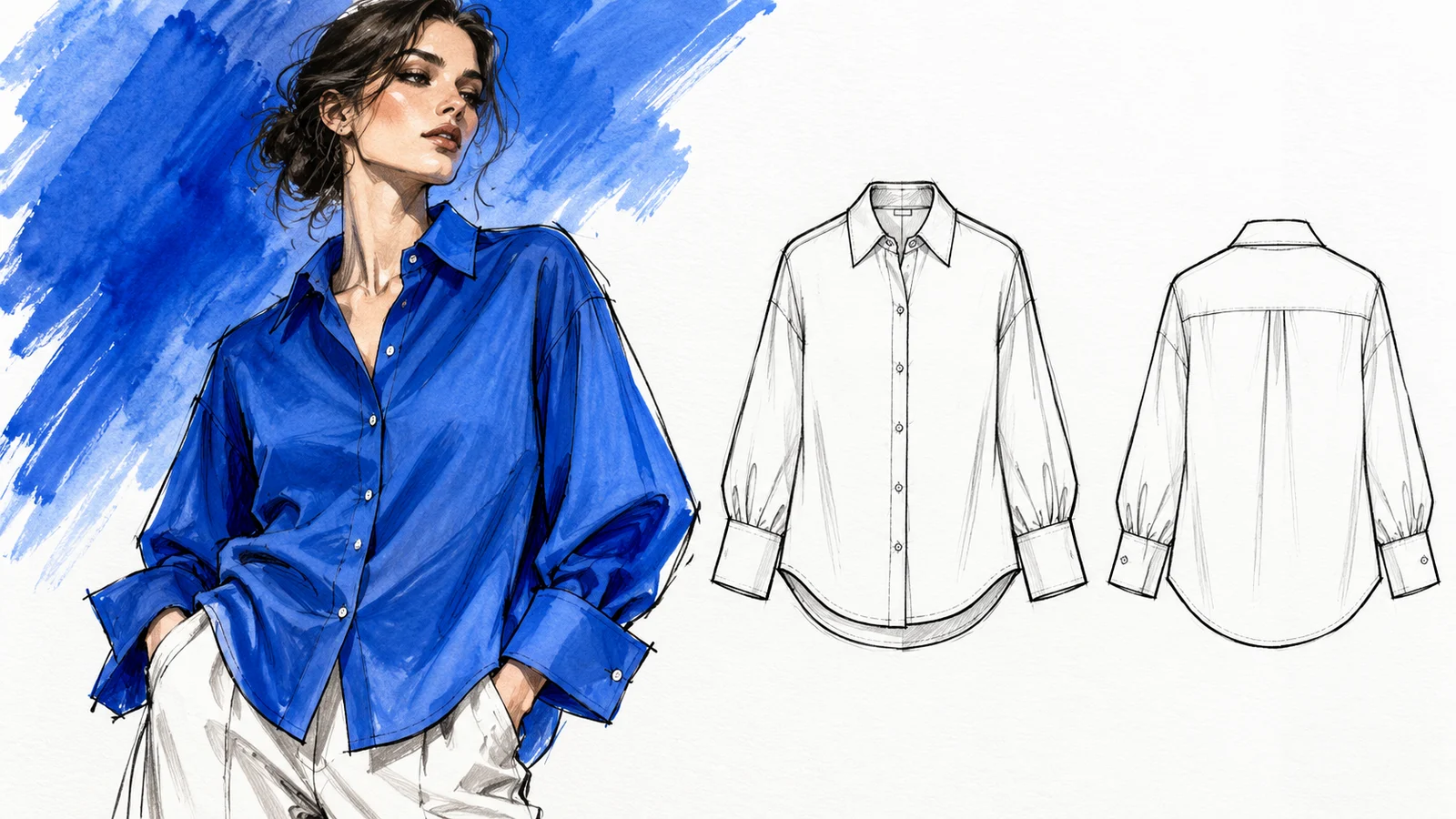
What changes when the purpose changes?
An illustration may use an exaggerated figure, selective shading and a strong pose. A technical flat normally removes those distractions so the garment’s seams, openings and proportions can be read. A flat can be drawn by hand or digitally: the communication purpose matters more than the tool.
| Question | Illustration can show | Technical drawing should clarify |
|---|---|---|
| What is the silhouette? | Overall impression on a figure | Front and back outline and style lines |
| What creates the shape? | Suggested folds or volume | Darts, seams, pleats, gathers and their positions |
| How does it open? | A visible fastening, if depicted | Closure type, location and relevant detail views |
| What must be measured? | Visual proportion only | References to a separate measurement method and specification |
Translate ambiguous marks into explicit decisions
Imagine a blouse illustration with three lines radiating from its shoulder. Those lines could indicate gathers, fixed pleats, drape folds or shading. A technical drawing should show the selected treatment and point to a note explaining it. Copying the lines more neatly leaves the ambiguity intact.
The same problem occurs at the waist. A narrow waist in a drawing does not establish whether the real garment uses shaping seams, darts, elastic or a belt. Decide which mechanism produces the intended shape, then show it consistently in all views.
Add the views the first image leaves out
A front-only view cannot settle the back neckline, yoke, vent or fastening. Add a back view even when the front is the main visual feature. Where an internal facing, lining attachment or concealed closure matters, provide a separate detail view with clear labels.
Use a line key if different line types have different meanings. A dashed line might indicate stitching in one pack and a hidden edge in another. State the convention and apply it consistently instead of expecting every supplier to interpret it the same way.
A technically clear drawing still needs specifications
A symmetrical flat can remain dimensionally undefined. Add the sample size, points of measure, measurement methods, target values, materials and relevant construction notes in the supporting pack. Do not assume someone can scale reliable centimetres from the width of a line on a screen.
UAL’s technical drawing course description includes seams, stitching, darts, pockets and fastenings as communication topics. That is a useful reminder that a technical flat carries information beyond the outer silhouette.
Review the two drawings together
Keep the chosen illustration and the technical views under the same style reference. Compare them before handoff: did the technical translation accidentally remove the dropped shoulder or change the position of the waist? If an intentional change was necessary, record it rather than leaving contradictory images.
For the earlier design stage, read why hand-drawn fashion sketches matter. For manufacturing preparation, use our woven-apparel tech pack checklist. KEYIDI TEXTILE requires a complete tech pack or physical sample garment for project review; a polished illustration alone does not meet that starting requirement.
Ready to Discuss Your Next Collection?
Send your garment brief, tech pack or physical sample details, fabric requirements, and target quantities for review.
Formal development requires a complete production-ready tech pack with specifications, or a physical sample garment. Concept sketches alone are not sufficient to start development.
Send Production Enquiry ↗Or email us directly at info@keyiditextile.com