
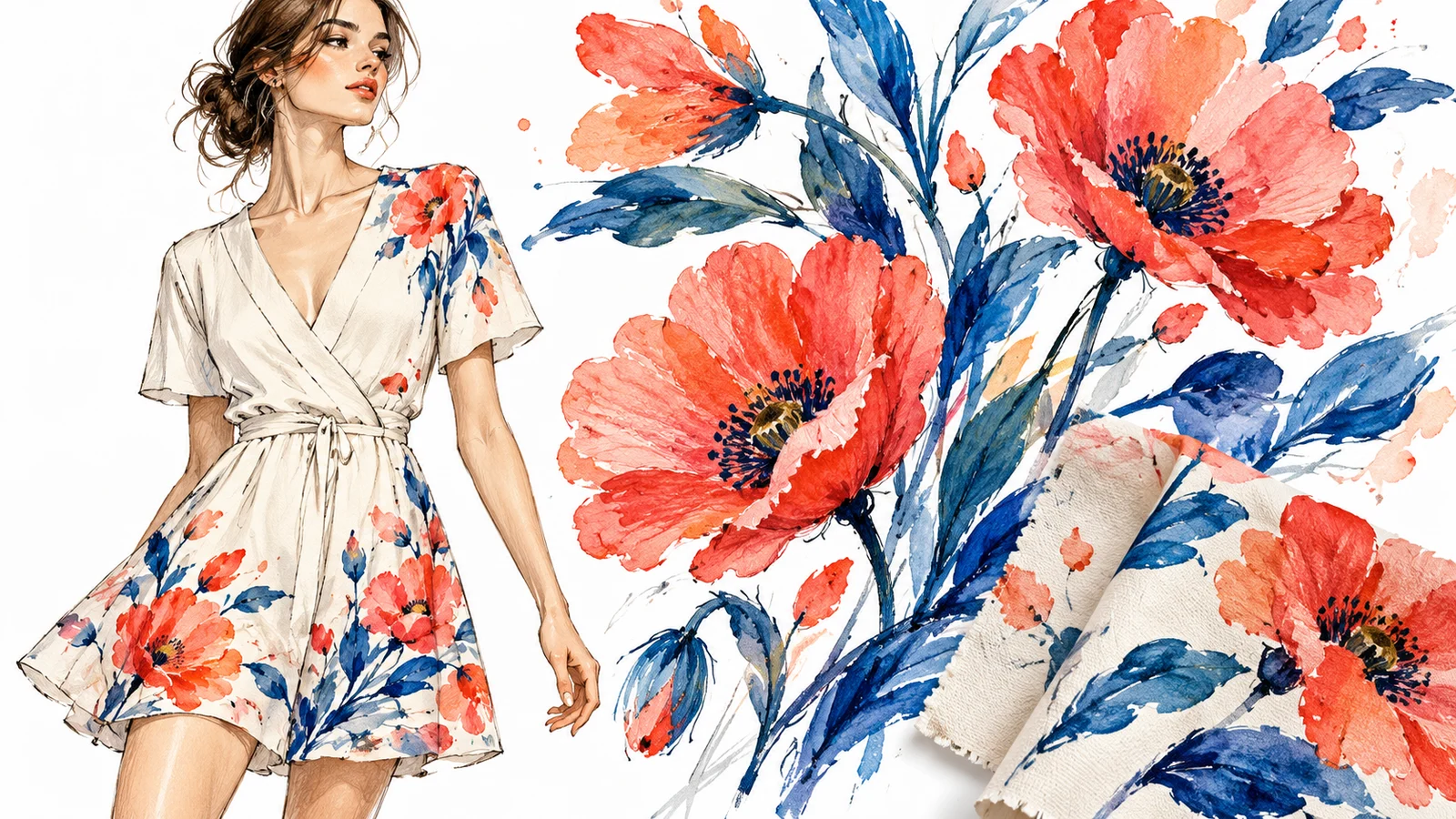
Print placement in garment design requires more than colouring a sketch. The drawing can show a proposed relationship between a motif and a silhouette, but production needs identifiable artwork, dimensions, orientation and placement instructions. The artwork and the garment drawing have connected but different roles.
Distinguish a repeat from a positioned motif
An all-over repeat covers a surface through repetition. A placement print locates a motif or composition at a defined position on the garment. State which system applies and whether a border, panel or engineered arrangement needs separate instructions.
A small flower drawn near the hem might indicate the general print character or an exact motif location. Clarify the intention. If placement varies with fabric cutting, say so; if alignment is a requirement, define the points at which it must be assessed.
Separate the artwork file from the appearance mockup
Provide the current artwork reference, its dimensions, orientation and colour instructions. Identify any background treatment and the expected printing scope. A screen mockup is useful for discussing appearance, but colour on a display is not physical colour approval.
Use artwork that your project is authorised to reproduce. A reference illustration, signature or motif found in a research folder is not automatically a production asset. Keep research imagery clearly separate from the artwork issued for making.
Locate the print from stable garment references
For an illustrative blouse with a single front motif, define its position from named references such as centre front and a specified neckline point. State the measurement method and whether dimensions refer to the motif’s bounding area or an internal registration point.
Account for seams, darts, pockets, fastenings and folds that cross the artwork. A motif that looks centred on an open flat may be partly hidden by a closed placket or gathered seam. Review the garment in the intended wearing state.
Decide what happens across sizes
Identify whether the artwork stays at one size, scales, or moves according to defined rules. Do not assume proportional scaling is appropriate for every size. The relationship between the motif, body and garment construction needs a deliberate choice.
If matching across a seam or opening is required, show which junctions matter and agree an acceptance basis. Some arrangements can affect cutting or process requirements; their feasibility and commercial effect need project-specific review rather than a generic cost claim.
Approve the right evidence
Separate approval of artwork content, physical colour, placement and the finished printed garment. A print trial can inform colour and process discussions while leaving garment fit unresolved. A fit sample in unprinted fabric does not approve final artwork positioning.
Record the approved file revision and relevant sample references. If the pattern changes after placement approval, check whether the print instruction also needs revision.
Read how technical flats connect details and how silhouette decisions affect the garment. Include artwork status with the material and construction information in a prepared enquiry to KEYIDI TEXTILE; submission does not confirm a printing process or production scope.
Ready to Discuss Your Next Collection?
Send your garment brief, tech pack or physical sample details, fabric requirements, and target quantities for review.
Formal development requires a complete production-ready tech pack with specifications, or a physical sample garment. Concept sketches alone are not sufficient to start development.
Send Production Enquiry ↗Or email us directly at info@keyiditextile.com